
Energy production from municipal solid waste: a detailed analysis
20 April 2026
The waste-to-energy (WtE) sector is undergoing a significant transition, both in Europe and globally. Decarbonization policies, circular economy objectives, and the progressive reduction in the use of landfills are redefining the role of waste treatment plants, which are now called upon to make an increasingly concrete contribution to the sustainability of the energy system. In this evolving scenario, the production of energy from municipal solid waste is taking on increasing strategic importance. Waste-to-energy is no longer just a solution for urban waste management, but represents a significant component of modern energy infrastructure.
In this article, we at Turboden offer an in-depth analysis of energy generation from municipal solid waste, examining the context, technologies, and prospects for development.
The advantages of generating energy from municipal solid waste
Generating energy from municipal solid waste offers a number of environmental, energy, and economic advantages that reinforce its role in integrated waste management strategies. The main benefits include:
- Significant reduction in waste volume: energy recovery processes reduce waste volume by up to 90%, limiting the use of landfills and land occupation.
- Cutting methane emissions from landfills: by avoiding traditional disposal, methane emissions generated by the anaerobic decomposition of waste are reduced, contributing to greenhouse gas mitigation.
- Production of electricity and heat from a constant source (baseload): waste-to-energy plants guarantee continuous and programmable energy production, supporting the stability of the energy system.
- Recovery of materials from residual ash: metals and inert materials can be recovered and reintroduced into production cycles, promoting the circular economy and resource recovery.
- Greater stability of energy costs: producing energy from waste reduces exposure to the volatility of fossil fuel markets and can benefit from dedicated incentive mechanisms.
- Reduction in overall emissions compared to landfill: thanks to the use of advanced filtration systems, modern plants guarantee high standards of emission control.
- Energy security: energy recovery from waste helps reduce dependence on imported fossil fuels, strengthening energy independence.
Technologies for recovering energy from municipal solid waste
Energy recovery from municipal solid waste is based on various technologies developed to maximize the energy content of waste and reduce the overall environmental impact of the process.
The most widely used technology today is direct combustion on a grate furnace. In this plant design, waste is burned in a mobile grate furnace; the heat generated by combustion is transferred to a heat transfer fluid through a boiler, producing steam that powers a turbine to generate electricity. This is the most established and widely adopted solution in medium and large waste-to-energy plants.
In addition to direct combustion, there are also solutions based on alternative thermochemical processes, including:
- Gasification, in which waste is converted into a combustible gas (syngas) through a high-temperature process in a controlled environment with limited oxygen.
- Pyrolysis, which occurs in the absence of oxygen and produces a mixture of gases, oils, and solid residues, which can then be recovered for energy purposes.
Traditionally, energy recovery plants use the Rankine steam cycle for electricity generation. At the same time, innovative solutions based on alternative thermodynamic cycles, such as the Organic Rankine Cycle (ORC), are gaining ground. These represent a technological evolution aimed at improving the efficiency and flexibility of plants, particularly in small and medium-sized applications.
The key role of the ORC (Organic Rankine Cycle) in generating energy from municipal solid waste
Among the innovative alternatives to the steam Rankine cycle, the Organic Rankine Cycle (ORC) is a technology particularly suited to the energy recovery of municipal solid waste, especially in small and medium-sized plants.
As mentioned above, in grate combustion plants, after heat recovery from the flue gases, the thermal energy is transferred to an intermediate circuit, generally using diathermic oil. In an ORC configuration, this heat is transferred to an organic fluid with a lower boiling point than water. The fluid evaporates, expands in the turbine generating electricity, and is then condensed to close the cycle.
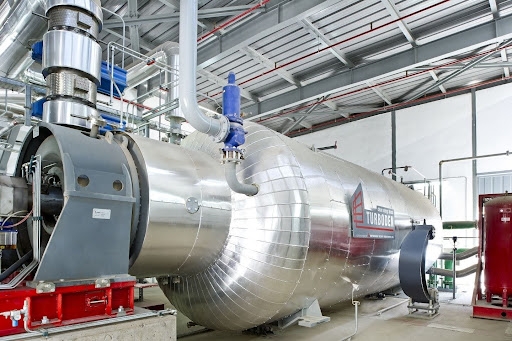
The main difference compared to the steam cycle lies in the ORC's ability to operate efficiently at lower temperatures and pressures. This makes it particularly suitable for applications where the available heat level, typically with diathermic oil between 200°C and 300°C, does not allow for the best use of a traditional steam turbine.
In plants up to approximately 20-30 MW thermal, replacing the steam turbine with an ORC system improves thermoelectric conversion, making more effective use of the heat recovered from post-combustion flue gases. In this sector, typical sizes range from 1 to 10 MWe of electrical power.
The main advantages of ORC compared to traditional solutions
Compared to configurations based on the steam Rankine cycle, ORC offers significant technical and economic advantages.
Technical advantages:
- Operation at low temperatures and pressures, with lower mechanical stress.
- No use of water for condensation, reducing water consumption and treatment-related issues.
- Greater operational flexibility, particularly suitable for small and medium-sized plants.
- Compact design and easy integration into existing layouts or limited spaces.
- Quick start-up and better modulation capacity compared to steam turbines.
- Simplified maintenance and greater overall reliability.
Economic advantages:
- Reduction in operating costs.
- Possibility of retrofitting existing plants to increase electricity production.
- Recovery of heat that would otherwise be lost.
- Competitive return on investment times when residual heat is available.
Turboden's contribution to the sector
In this complex context, characterized by the need to combine energy efficiency, environmental sustainability, and operational reliability, Turboden plays a key role in the development and construction of ORC plants for energy recovery from municipal solid waste. Thanks to its consolidated experience in the design and supply of Organic Rankine Cycle-based turbogenerators, the company is able to offer optimized technological solutions for the recovery of heat in waste-to-energy processes, particularly in small and medium-sized plants. Turboden solutions stand out for their high level of plant integration, operational reliability, and ability to adapt to the specific thermal and logistical conditions of each project. The use of ORC systems maximizes electricity production from available heat, improving the overall performance of the plant and contributing to the sustainability of the local energy system.
A representative example is the plant built in the United Kingdom, designed to treat approximately 24,000 tons per year of RDF (Refuse Derived Fuel). The plant is equipped with a Turboden ORC system with an electrical power of 2.4 MWe. The environmental and energy performance of the project is significant:
- Annual electricity production: approximately 19,200 MWh
- CO₂ avoided: approximately 4,474 tons per year
- Equivalent number of cars taken off the road: approximately 973 vehicles
- Homes powered: approximately 5,333 units
This case demonstrates how integrating ORC technology into waste-to-energy plants makes it possible to transform municipal solid waste into a reliable energy resource, contributing significantly to reducing emissions and transitioning to a more sustainable energy system.
To learn more about how to integrate ORC technology into a waste-to-energy plant or evaluate a retrofit solution, contact the Turboden team: our experts are available to analyze the specific needs of your project and identify the most efficient configuration.
