
Mechanical vapor recompression (MVR): the electrification of industrial heat for energy efficiency and decarbonization
A detailed analysis of the importance of this technology for energy saving in the industrial sector
02 December 2025
Energy efficiency and the decarbonization of industrial processes are among today's top priorities. In this context, the electrification of heat associated with waste heat recovery is a key lever for reducing both energy consumption and CO₂ emissions. One of the most promising solutions in this area is mechanical vapor recompression (MVR), a technology that generates steam using waste heat from production processes, thereby increasing its pressure and temperature to make it available again under the necessary conditions.
What is Mechanical Vapor Recompression (MVR) and how does it work?
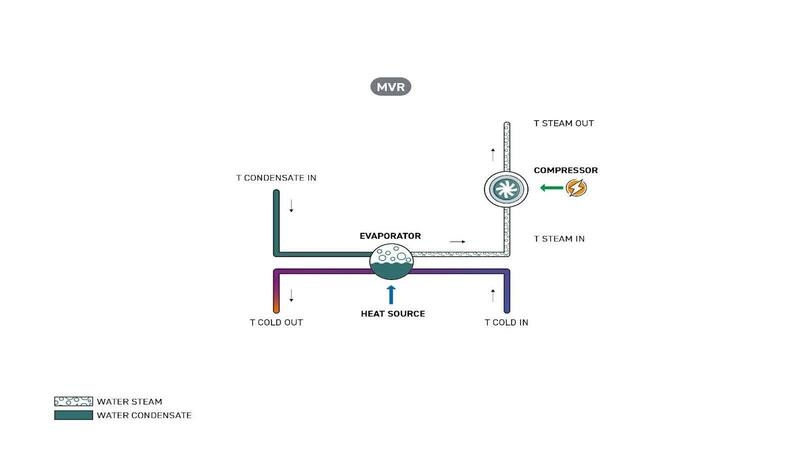
Mechanical vapor recompression (MVR) can be considered as an open-cycle water heat pump. The process begins with the use of a medium-high temperature heat source, which allows water to evaporate in a heat exchanger.
The steam generated is then sent to a steam compressor, which increases its pressure and temperature to the desired conditions, making it suitable once again for meeting the thermal demand of the industrial process. The result is a closed cycle of energy recovery and utilization, as well as increased process sustainability.
What are the main advantages of this technology?
Mechanical vapor recompression offers a number of advantages:
- High energy efficiency: when the available heat source is at temperatures above 80°C, MVR is the technology with the best performance and lowest operating costs.
- Emissions reduction: using electricity (especially renewable energy) to power the compressor drastically reduces the carbon footprint.
- Flexibility: the technology can be adapted to different industrial sectors and different temperature and pressure requirements.
What criteria should be considered when choosing this technology?
The adoption of an MVR system depends heavily on the thermodynamic parameters of the process.
Aspects to consider include:
- the temperature of the available heat source,
- the pressure and temperature of the steam required by the process,
- the continuity of the heat demand, which makes the investment more cost-effective.
Main applications of MVR
Mechanical vapor recompression is used in numerous industrial sectors:
- Food & Beverage: crystallization and concentration processes.
- Pulp & Paper: steam generation for paper drying.
- Chemical and pharmaceutical: distillation and concentration.
- Refinery and petrochemical: separation and purification processes.
- CCS (Carbon Capture and Storage): as a stand-alone technology or as a steam compressor combined with large heat pumps to improve the overall efficiency of the system.
What other technologies can MVR be used with?
An MVR can be used either independently, when a medium-high temperature water source is available, or in combination with large industrial heat pumps.
In the latter case, the vapor compressor allows higher output temperatures and pressures to be achieved than those obtainable from a single heat pump and/or improves overall performance.
The key role of Turboden
Mechanical vapor recompression is now a mature, efficient, and versatile technology capable of significantly reducing energy consumption and CO₂ emissions in industrial processes.
An example of this technology developed by Turboden, a Mitsubishi Heavy Industries Group company and leader in technological solutions for decarbonization, is the innovative tailor-made thermal upgrade system designed and installed to integrate an industrial heat pump with a mechanical vapor compressor. This configuration is capable of exploiting low-temperature heat (between 10°C and 20°C) and, using “green” electricity, generating 12 MWth of superheated steam at 170°C.
With solutions like this, we at Turboden demonstrate how technology can be adapted to the specific needs of our customers in industrial processes, providing high-temperature heat without emissions and effectively accelerating the transition to a sustainable industry. Contact us now for more information!
